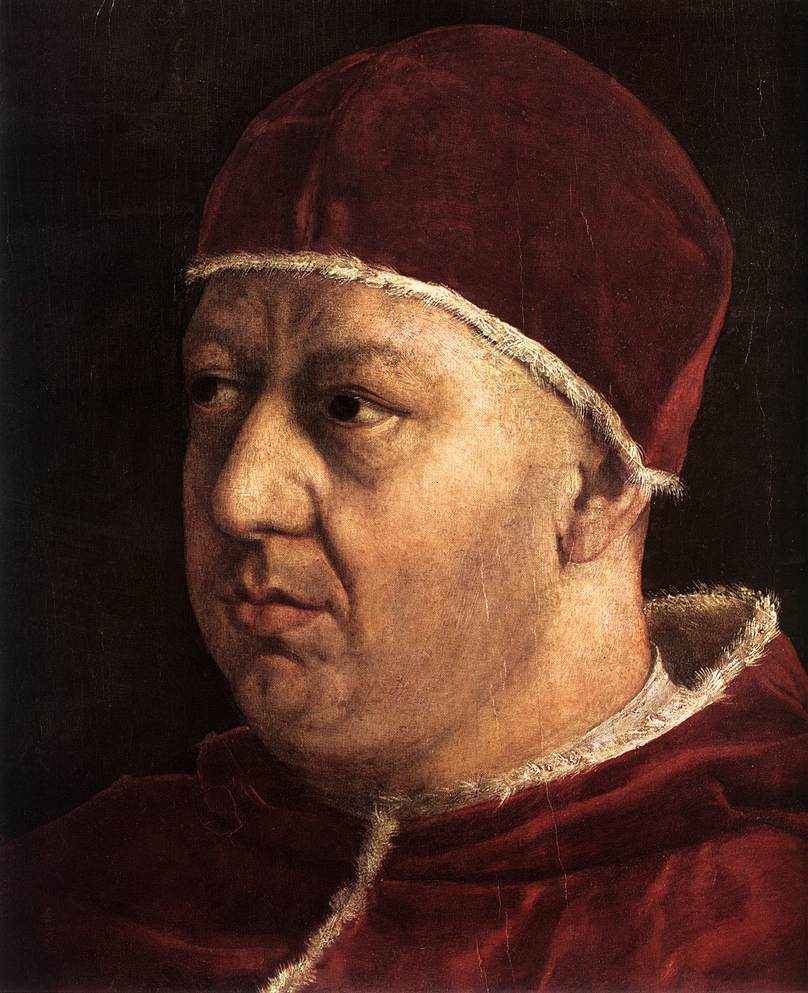
In today’s world, one of the most successful heresies is the heresy of Protestantism. This heresy has its beginning in 1517, when Martin Luther nailed his disputatio pro declaratione virtutis indulgentiaru, or his Ninety-Five Theses unto the door of the All Saints Church in Wittenberg, Saxony (now Germany), in an effort to start a dialogue regarding several perceived abuses within the Holy Mother Church and Her clergy. This entirely reasonable call for discussion started a back-and-forth between Luther and his followers, and the Holy Mother Church, as led by Pope Leo Xi. Leo acknowledged several of Luther’s complaints, but also demanded that Luther retract forty-one errors that were seen as irreconcilable with the teachings of Sacred Tradition within a certain period of time. When this time expired, Luther performed the dramatic gesture of burning both his copy of the Papal Bull making the demand, as well as several volumes of Canon Law, the ecclesiastical law of the Holy Mother Church, reportedly saying, “Because you have confounded the truth of God, today, the Lord confounds you. Into the fire with you!”
Needless to say, this direct act of rejection of the pontifical authority, as well as the heretical rejection of the authority of Sacred Tradition were considered unacceptable, and constituted schismatic acts. From this, we see the beginnings of the Protestant movement. This movement grew in popularity for reasons we shall examine in another article, and became one of the most successful heresies in the world.
As we look at these heresies from a modern perspective, we see an overwhelming amount of diversity; from the comparatively ceremonial and hierarchical Anglican Communion, to the charismatic and zealous Pentecostal movement. However, throughout the vast majority of Protestant movements, there are several unifying factors. These are known collectively as the Five Solas, or, in English, the Five “Alone”s. By name, they are, sola Scriptura (by Scripture alone), sola fide (by faith alone), sola gratia (by grace alone), solus Christus (Christ alone), and soli Deo gloria (glory to God alone).
This article is the first of a series of five examining what these Solas mean in their various incarnations, and whether or not they err, as well as some of the reasons that many men seem so eager to comply with these doctrines. It is our hope that the reader shall see these articles for what they are, not a blind attempt to condemn the practitioners of the protestant movementii , but rather, an attempt to dialogue and expose errors of which many modern Protestants may not be aware, or at the very least, haven’t thought about in detail, which is to say, what we do, we do in our charity, with loving intentions. To further this end, we shall look at these Solas from a rational and sober standpoint, the first of which being sola Scriptura.
Sola Scriptura is a very interesting doctrine, and one to which the reader may not even be aware that he subscribes. Often, Catholics, in our various discussions with members of Protestant denominations come across the argument that whatever it is that we are saying “Isn’t in the Bible.” This argument seems superficially convincing to many modern men, and is a direct consequence of the doctrine of sola Scriptura. Simply put, the doctrine of sola Scriptura in its strongest form is, “All extrascriptural doctrines are, by virtue of them being extrascriptural, false.” This can be phrased in an equivalent form, “Sacred Scripture is exhaustive when it comes to doctrinal truth.”
This argument is one with which faithful Catholics take grave issueiii. In the Catholic communion, we have what can be accurately deemed a superset of Sacred Scripture called Sacred Tradition, which has for two Millennia been the basis of our beliefs and ideas, and indeed, predates Sacred Scripture by approximately four centuries, as well as the episcopacy, which is essentially the hierarchical structure of the Holy Mother Church, as led by Her Bishops, which actually was the force that begot Sacred Scripture as we know it today.iv
Let us look at the way that sola Scriptura in its strongest form, ultimately fails. The simplest argument is that it is self-contradictory. We lay this out:
I. Sola Scriptura holds that all extrascriptural doctrines are false. (definition)
II. Sola Scriptura is a doctrine. (premise)
III. Sola Scriptura is not indicated by Sacred Scripture. (premise)
IV. Sola Scriptura is an extrascriptural doctrine. (by definition of extrascripturalv and conjunction introduction from II, and III)
V. Sola Scriptura is false. (Modus Ponens by I and IV)
We can clearly see from this argument, that if II and III hold, then the conclusion V is conclusively true, given the standard rules of logic. Thence, our goal is to demonstrate the validity of II and III. To further this goal, we examine the definition of Doctrine, as used in this context, “a particular principle, position, or policy taught or advocated, as of a religion or government.” To show that this is a doctrine, we simply have to prove that it is advocated by Protestantism, which is trivially done. As such, we have shown that II is true by definition.
This leaves us with the most significant issue, showing that III is true. In order to conclusively prove this premise, we should have to examine each and every individual verse contained within the full canon of Sacred Scripture, and all the interpretations thereof, to show that they are irrelevant to the doctrine, which, while a worthy endeavor, is significantly beyond the scope of this article. Therefore shall we content ourselves to examine the verses which may superficially appear to falsify III. However, because of the non-exhaustive nature of this exercise, the reader is encouraged and challenged to find verses which may support sola Scriptura on his own, and, if a convincing argument is found, to forward it to us for explanation or rebuttal.
One of the common verses cited in support of sola Scriptura is 2 Timothy 3:16-17:
“All scripture, inspired of God, is profitable to teach, to reprove, to correct, to instruct in justice, that the man of God may be perfect, furnished to every good work.”Proponents of sola Scriptura argue that this verse claims that the Sacred Scripture contains every doctrinal truth, so we shall take a look at this claim in greater detail. The only portion of this verse that seems to imply exhaustiveness is “furnished to every good work.” However, this immediately and trivially demonstrates itself to be completely irrelevant to the actual claim of sola Scriptura which is that Sacred Scripture is exhaustive with regards to doctrinal truth. Let us look at this verse piece by piece.
“All scripture, inspired of God, is profitable. . .” The claim that all scripture is inspired of God is definitely not one with which any Catholic would hold an objection, but what exactly is meant by “profitable”? Is it that it is in any way exclusive with regards to extrascriptural teachings? We now look at the original Greek word that has been translated as profitable, which is ophelimos. Ophelimos is best translated as “useful,” which indeed is synonymous, in this sense, with “profitable,” but is a great deal clearer. Useful underscores the fact that there is more to doctrinal truth than what is writ. Just as it is useful to read a text on Abstract Algebra when studying Mathematics, or useful to know the Greek alphabet when studying Greek, so is it useful to know Sacred Scripture. However, useful does not in any sense of the word imply exclusivity. One cannot say, “It is useful to use training wheels when teaching a child how to ride a bicycle,” to mean, “One may only teach a child to ride a bicycle with training wheels.” The very concept is absurd.vi
We continue with our analysis of this verse. “. . . to teach, to reprove, to correct, to instruct in justice, that the man of God may be perfect,” No Catholic takes issue with the fact that Sacred Scripture teaches, reproves, corrects, instructs in justice, or begets perfection. In fact, as a subset of Sacred Tradition, these are some of the explicitly expected purposes of Sacred Scripture. However, when one uses perfection in the context of complete knowledge of doctrinal truth, a Catholic begins to balk.
It is very apparent that perfection, as used in this context, is not total perfection, which is to say, one shouldn’t expect to become omniscient or omnipotent from reading Sacred Scripture, things which are encompassed in total perfection. So what sort of perfection is meant by this verse? It is very apparent that what is meant is moral perfection, which is necessary to enter the kingdom of God. How does one become morally perfect? By never sinning, given complete knowledge of all wrongdoings? Decidedly not, unless one happens to be the Son of Man, in which case, Scripture is hardly necessary to him. Rather, we obtain perfection only through forgiveness of sins, and more specifically, through the Sacrament of Penancevii, the basis of which is set forth within Sacred Scripture. It is very clear, given that there is only one way to obtain perfection, that it is to this that Sacred Scripture refers, not to exhaustive documentation of all doctrinal truth.
We conclude our analysis with what appears to be the strongest champion of exhaustiveness, indeed, the only one that can be taken, even superficially, to be exhaustive, “. . . furnished to every good work.” What exactly is meant by this final portion? That Sacred Scripture is exhaustive with regards to knowledge begetting good works? Rather, it shows that Sacred Scripture is profitable (i.e., useful) in making a man furnished to every good work. The structure of the verse is as follows: One teaches, reproves, corrects, instructs in justice for the purpose of making the man of God perfect and furnishing him for every good work. Sacred Scripture is profitable for the purpose of teaching, repoving, etc. . . and thus is profitable for making a man perfect, and furnishing him for every good work. The verse in no way implies that it is the sole source for furnishing him to every good work, but merely a useful one.
Having shown that the verse does not in any form support sola Scriptura, we should like to show that nearly immediately preceding the verse is 2 Timothy 3:14, which very clearly argues against sola Scriptura:
“But continue thou in those things which thou hast learned, and which have been committed to thee: knowing of whom thou hast learned them”Saint Paul here makes an appeal to Sacred Tradition, including Sacred Scripture, as he speaks in general terms. It is evident that he does not refer to all things “which thou hast learned” in any sort of universal sense, as it would be immoral and inconsistent for him to, say, advocate continuation in sin, which men of that era, as our own, obviously have learned. But rather, he makes it obvious that we are to continue what we have learned if we “[know] of whom thou hast learned them,” i.e., if the source is a reputable authority (with the ever-present implicit clause that what we have learned does not contradict any infallible moral teachings, which is to say, Sacred Tradition, including Sacred Scripture).
One of the next most common verses to defend sola Scriptura is Apocalypse 22:18-19:
“For I testify to every one that heareth the words of the prophecy of this book: If any man shall add to these things, God shall add unto him the plagues written in this book. And if any man shall take away from the words of the book of this prophecy, God shall take away his part out of the book of life, and out of the holy city, and from these things that are written in this book.”This section is very easily refuted, as New Testament canon had not been collected into a book at the time of writing, and not for another four hundred years thereafter, Saint John cannot have possibly meant the entire canon. John refers to the prophecy of this book, and not the teachings, which further supports this argument, for Apocalypse is unique in that it is nearly entirely a prophecy, albeit one with a great deal of instruction, whereas the rest of the New Testament canon is not primarily prophetic, but rather instructional.
Having refuted the primary verses offered in support of sola Scriptura, we have shown that premise III from our argument holds, although we do note that several other verses exist in support of sola Scriptura, we hold that they fall victim to similar arguments, which can be given for a particular verse upon request. If logic alone does not convince the reader, then we shall end our article with exposition as to scriptural support for arguing against sola Scriptura, and a brief note about the less strict definition of sola Scriptura, or “prima Scriptura.”
Saint John 20:30 is rather explicit in saying that not all of the signs of Christ were recorded:
“Many other signs also did Jesus in the sight of his disciples, which are not written in this book.”This means that there exist acts of Christ outside of scripture, i.e., extrascriptural acts of Christ, which are doctrinally true. This immediately contradicts Sola Scriptura, which, per the definition, would argue they never occurred, by virtue of them being extrascriptural. Likewise, we have Saint John 21:25:
“But there are also many other things which Jesus did; which, if they were written every one, the world itself, I think, would not be able to contain the books that should be written.”This verse not only states that there are true extrascriptural acts of Christ, but that they vastly outnumber the scriptural acts of Christ, which is entirely consistent with the idea that Sacred Scripture is a subset of Sacred Tradition, and in fact, strongly supports it.
It should be known that numerous other verses exist that likewise, given proper interpretationviii, conclusively prove that there exists true, extrascriptural doctrinal truth, however, given the limited scope of this article, they are not recorded here. (Not to say this article isn’t profitable to read, it’s just non-exhaustive.)
We conclude our article with a note on the less strict interpretation of Sola Scriptura, which is that nothing may ever contradict Sacred Scripture, but there do exist extrascriptural truths. This interpretation, referred to here as prima Scriptura, is entirely consistent with Catholic beliefs, in that Sacred Scripture is a subset of Sacred Tradition, and Sacred Tradition, in order to be meaningful, cannot contradict anything contained within it. As Sacred Scripture is contained within Sacred Tradition, it is very clear that Tradition cannot contradict Scripture.
It is our honest wish that the reader meditate on this article and look at his beliefs honestly and fairly and, if he finds a rebuttal, that he give it to us, that we may discuss and approach the truth.
Yours in faith,
Johannes van Liempt
i. See Exsurge Domine for Pope Leo X’s response to the 95 Theses. Further, note that a later article series will deal with the objections brought forth within the 95 Theses, in the interest of furthering discussion and approaching the truth.
ii. St. John 3:17
iii. Not to say there aren’t “Catholics” who would agree with this argument, but more that it is antithesis to the teachings of the Holy Mother Church.
iv. The New Testament canon was not established until the Synod of Hippo, under St. Augustine, although Athanasius, from whom this blog receives its name, did accurately predict the precise set of texts that would become the New Testament canon.
v. Extrascriptural is defined as “not indicated by Sacred Scripture”.
vi. Titus 3:8 and 2 Timothy 2:21 fall victim to the same demonstration of the meaning of profitable.
vii. The necessity of the Sacrament of Penance will be demonstrated in a later article, until then, feel free to ignore this bit.
viii. Which is to say, interpretation not misguided by the heresy of individualism; more about this heresy in a future article.


No comments:
Post a Comment
Thought before action, always.